Saturday, July 25, 2026

Film Review: "The Odyssey"


Christopher Nolan’s “The Odyssey” is a gutsy, inventive reimagining of Homer’s epic poems. His shaggy god story also samples Virgil’s tales of brave Ulysses. You’ll see the Cyclops, the Trojan Horse, Circe, Scylla and Charybdis. Scary monsters! Angry gods! Sweaty Greeks! Step right up! 

There's a lot to see here. But Nolan’s movie isn’t a clip show of Homer’s greatest hits. Odysseus’ return voyage to Ithaca fuses the episodes into a story. Homecoming was the spine of Homer's original story, natch. In Nolan’s retelling, the story builds. It's now character-based storytelling. And not just Odysseus’ character. 

The movie’s crowded with unique, well-drawn individuals. They all change, not always for the better. Odysseus changes most of all. He’s not just coming home and taking back what’s his. He’s reclaiming his own humanity after perpetrating war crimes. See what the director/screenwriter did there? 

Nolan’s pulled a clever bait-and-switch.

“The Odyssey” starts out as a homecoming saga.

Presto-chango! 

It's an anti-war parable. 

“Zeus Law” is the secret of Nolan's switcheroo. It’s based on “xenia” — the sacred hospitality that ancient Greeks owed to strangers in a strange land. A good host should welcome them, feed them, clothe them, and above all, don’t kill them. They might be gods in disguise. The flip side? Guests shouldn’t pig out, abuse their welcome, double-dip, or kill their hosts. 

That's a valid Homeric concept. Zeus was the protector of strangers and guests. So, it’s his law. Nolan just gave it a name — and hoped the audience would miss his sleight of hand.

Magic aside, the movie’s themes are simple:

Be kind to strangers visiting your home.

Don’t kill strangers in their homes.

These are Nolan’s themes, not Homer and Virgil’s. It's not his only change.

Homeric culture wasn’t Woodstock. It was a warrior culture. Hierachical, patriarchial, sexist, violent, nasty, poor, brutish and short. Mass murder was something to sing about. Peace love and understanding wasn’t the Greek way. "Zeus' Law"  was fine print. "Kill them all, let the gods sort it out" was the main commandment. 

Homer’s Odysseus was a cocky, boastful bastard from start to finish. He's the better killer — and proud of it. Nolan's Odysseus repents. The sack of Troy fills him with guilt. Unlike Homer's hero, he learns his lesson. Fine by me.

Nolan’s “Odyssey” has a multicultural cast. So what? Peter Brook’s "Mahabharata," was too. I’m cool with that. And all his other changes.

Homer's epic is bulletproof. It survives endless reinvention. It's a sacred homecoming story — and it launched a thousand stories. James Joyce's "Ulysees" made it the tale of a cuckolded Jewish ad salesman. The Coen Brothers' "O Brother Where Art Thou?" turned it into a redneck odyssey. Stanley Kubrick's "2001: A Space Odyssey" blasted it into outer space, infinity and beyond. Nolan's earthbound "Odyssey" makes a lot of strange changes. That's not my beef.

The movie's just too damn long. It's just that simple.

Nolan's film clocks in at 2 hours and 52 minutes. The whiz-bang scenes are spectacular. But they go on and on and on. The pacing drags. The flashbacks have flashbacks. The story wanders, meanders, goes off course. Enough already! Get on with it!

Don't get me wrong ...

Nolan's "Odyssey" is a heartbreaking work of staggering genius.  His long, strange trip is well worth taking. 

But it's just too damn long.


Review: "The Last Temptation of Christ"

Today’s lesson: “The Gospel According to Martin Scorsese.” Jaysus, where do I begin? Let’s start with the writer ….

Nikos Katzanzakis (NK) wrote the novel — but he was more like an ecstatic prophet than a writer. His white-hot words wrestled with opposing visions. NK was a mystic electrified by the power of the living God. He was also a nihilist facing the absolute emptiness of life, the universe and everything. Beautiful writing — that often sounds like a madman’s ravings. NK's God-drunk Jesus was the maddest of all.

“When I say ‘I,’ I do not speak of this body — which is dust; I do not speak of the son of Mary — he too is dust, with just a tiny, tiny spark of fire. ‘I’ from my mouth … means God.”

That’s a mild example. NK’s Jesus dials it up to 11. He’s a full-on mad prophet at all times. How the hell do you have a movie out of that?

Martin Scorsese seems like the ideal director. Just make Jesus as intense as De Niro in “Raging Bull” or “Mean Streets.” But Scorsese didn’t. The film’s Jesus (Willem Dafoe) is a mild-mannered carpenter. Who speaks in the low tones of a soporific NPR announcer. Dafoe’s blow-dried blonde haircut makes you think Jon Peters was the film’s uncredited hairdresser. His Malibu Jesus isn't scary at all. 

So, why’d Scorsese pull his punches? My hunch: The unholy reaction to “The Life of Brian” made him flinch. He wanted to be faithful to the book — without pissing off any religious fanatics. To do that, Scorsese diluted the novel's terrifying, holy madness. The result wasn’t faithful to anybody.

To be fair, it's a hard book to adapt. (Duh.) In Kazantzakis’ novel, Jesus’ spiritual struggle was mainly an inner struggle. His human self wrestled with an incomprehensible, unpredictable Divine Other that relentlessly tried to possess him. In NK’s novel, Jesus kept that struggle to himself — aside from a few cryptic utterances. (The Biblical Jesus did that, too.) If Jesus spoke his thoughts and made his inner life public, it would cheapen it. Implying Jesus’ Divine Madness was the only way to do it. Mush-mouth equivocation was not. But that's a matter of direction and delivery, not the script.

Paul Schrader* wrote the screenplay. Not a man to pull punches, eh? The film’s fault is in its stars — and a director who (uncharacteristically) played it safe. (Blame mean nuns with metal rulers. But I speculate.) I'll cut to the chase ...

After an hour of mumbling and misdirection, the film finds its spine (and balls) in Jesus’ arrest, trial, crucifixion, and crisis of faith. David Bowie’s Pontius Pilate is a polite, upper-class British prig who’d rather not nail this silly sod up — but wastes no time arguing with a backwater lunatic who thinks it’s his destiny.

Spoiler alert: The Romans crucify Jesus. He hangs on the cross. The devil appears to him as an Angel of Light. Or a cute young chick. This luminous lady de-crucifies him. Jesus lives out a normal human life. He marries Mary Magdelene, has kids, the whole nine yards. That’s the last temptation, get it? But the world is out of joint. Jesus knows it. And know what he must do. He gets back to work, gets back on the cross, and dies for our sins. 

That’s the heart of Kazantzakis’ book and the heart of Scorsese’s movie. It was weak tea before — and strong wine now. Scorsese should’ve stuck with that — and ditched the set-up. Whatever my caveats and kvetches, I admire his iron balls making this movie in the first place.

If the film had skipped the set-up and jumped to Jesus’ "last temptation" on the cross, it might have worked. (Spoiler alert: Satan tempts Jesus with a normal human life — which he lives in an eyeblink like Picard in “The Inner Light.” At the last possible second, Jesus returns to the cross and gets the job done.)

Scorsese got the job done — but this doesn’t feel like a Scorsese movie.

As an added sin, this film echoes the revived anti-Semitic tropes of 2026. (Jews throwing stones, Jews haggling about money, etc.) That wasn’t on Scorsese’s radar in 1988.

It’s a cross he’ll have to bear

*Were there world enough and money, I’d compare NK's novel to Schrader’s screenplay line by line. But there isn’t — so I won't. Sorry.


Friday, March 14, 2025

Atlas Barfed

In Ayn Rand’s “Atlas Shrugged,” America’s billionaires go on strike. Their creative minds are the motor that runs the world. But the evil, incompetent socialist government taxes them and tells them what to do with their stuff. So, they all join forces with John Galt in his super-secret redoubt in Colorado. The corrupt capitalists everybody blames for everything are finally gone! Yay! In less than a year, the shit hits the fan. The pinko second-raters and takers can’t America work. (Seems they need those corrupt capitalists after all.)  So trains derail, electricity fails, it’s anarchy, total collapse, the end of civilization! Almost. The billionaires wait it out. One character sits in his cabin and rewrites the United States constitution …

“He had marked and crossed out the contradictions in its statements that had once been the cause of its destruction. He was now adding a new clause to its pages: ‘Congress shall make no law abridging the freedom of production and trade...’”

Then, when everything goes to hell, the billionaires at last emerge.

“They could not see the world beyond the mountains, there was only a void of darkness and rock, but the darkness was hiding the ruins of a continent: the roofless homes, the rusting tractors, the lightless streets, the abandoned rail. But far in the distance, on the edge of the earth, a small flame was waving in the wind, the defiantly stubborn flame of Wyatt's Torch, twisting, being torn and regaining its hold, not to be uprooted or extinguished. It seemed to be calling and waiting for the words John Galt was now to pronounce.

"The road is cleared," said Galt. "We are going back to the world."

He raised his hand and over the desolate earth he traced in space the sign of the dollar.”

I think “Atlas Shrugged” is the game plan for America’s oligarchs. To speed up the destruction, they’ve installed idiots in charge of the United States government. Thanks to this hand-picked wrecking crew, a Greater Depression will likely result — and possibly WWIII. After that, the oligarchs will kick off any remaining taxes or legal restraints.

The bullies don’t want any coaches on the playing field.

Interesting times, huh?


Monday, October 14, 2024

Tweedledumb and Tweedledamned

I think there’s a freaking tank of comatose psychics in Russia a la “Minority Report.” They’re broadcasting thoughts to America’s weak-mind liberals and leftists: "Don’t vote for Harris. Israel bad. Harris bad. I am a good person. I won’t vote for Harris." Their sleepy-headed targets mumble this call-to-action in hypnagogic half-sleep. "I am a good person. I won't vote for Harris."

Why not?

Here’s the reason the psychics project …

"Trump and Harris are Tweedledum and Tweedledee. Equivalents. Two evil sides of the same evil coin."


And that’s bullshit.

The truth is …

If Trump wins, the Iron Heel will stomp us all in the face. He’ll pack the Supreme Court (and federal judiciary) beyond any hope of future balance. Democratic victory won’t matter anymore. Liberal/progressive political philosophy will be declared unconstitutional. The Supreme Court will probably roll back previous decisions affirming LGBTQ rights. After that ...


Trump will pay back the people, organizations, cities and states that didn’t kiss his ass. McCarthy-era show trials will be the height of fashion. Along with blacklists and deportations. He’ll turn the Justice Department into the President’s blindly loyal squad. He’ll gut or eliminate the FBI and CIA — or turn them into his personal Gestapo. He’ll fire non-political government employees who might say “no” and replace them with pre-selected blind loyalists. He’ll build that freaking wall at the Mexican border at a cost that could probably create a domed city on Mars. For a few dollars more, he’ll build concentration camps to house undocumented immigrants — in a brief unpleasant stay, before kicking them out. He’ll wipe out any shred of independence in the educational system, kill liberal arts programs, and reduce American universities to trade schools. He’ll kill the Education Department and gut or kill the EPA. He’ll institute libel, treason and sedition laws that’ll silence annoying critics in the no-longer free press. He’ll give John Galt-style supermen like Elon Musk and Jeff Bezos the legal right to control, censor, own, and manipulate the flow of ideas. He’ll amp up extra-legal militias and death squads. He’ll legitimize the whack-job conspiracy theorists of Q-Anon. He’ll withdraw from NATO and other global alliances. He’ll stand by while Russia brutally absorbs Ukraine, and China does a fiery blitzkrieg on Taiwan. The Supreme Court will reverse its decisions on LGBTQ rights. No more gay marriages or trans people in bathrooms. They’ll revert to an absolutist state’s rights theory, including the elitist idea that state legislators and run elections (or select electors) any way they want. He’ll kill the independence of the Federal Reserve, cut all the taxes (for rich folks) he can, and kill all those pesky laws preventing America’s hard working entrepreneurs from working employees to death, selling deadly products, and pumping poisons in the air and water. The American economy will go down the toilet faster than you can say “Herbert Hoover.” He’ll attack the problem with the default authoritarian solution. We’ll go to war with somebody, probably Iran. Or maybe Samoa. Who the hell knows?

That’s the awful truth.

The Trump/Harris equivalency meme is disinformation.

It’s a lie. 

Otherwise known as bullshit.


Thursday, January 19, 2023

Marty Fugate Critic Seminar Q+A


What’s the function of a critic?

On the level of the university or national publications, that’d be someone who analyzes the merits and faults of a literary or artistic work ­— or, for that matter, a fad, philosophy or social movement. In terms of popular media, you’re more like a professional poison taster. “’Avatar II’ sucks … aggghh! Don’t see it!” But most real critics (even that late Roger Ebert) hate that part of the job --- and only begrudgingly do it when they have to. Thumbs up, thumbs down. Pfft! I’m not the Emperor Nero.

What education should a competent critic have?

If you’re an English major or have a degree in journalism, if can’t hurt – but it doesn’t make you a critic. It’s not like the Wizard of Oz gives you a critic certificate. Plenty of writers without specialized degrees were (and still are) great critics. Plenty of credentialled critics don’t know what they’re talking about.

 A critic can make or break a show or an exhibit. Is that right?

That’s not been my experience, at least on the local level.

 Has criticism changed over the years? How?

The primary change is economic. If you’re considering a professional career in the 21st century, blacksmithing or buggy-whip manufacturing would be much more lucrative. From the standpoint of pure ideas, it’s gotten harder to confine yourself to the realm of pure ideas. Political gatekeepers have crashed the party – including PC gatekeepers on the left, and right-wing gatekeepers on the right. What you say CAN hurt you now … and that’s all I’m going to say on the subject.

Do personal biases interfere with a critic’s job?

I’d say they’re part of the job description … at least for now. Silicon Valley has created AI systems that generate amazing art. AI critics are probably on the horizon in the not-too-distant future. Until then critics are not robots. Critics are human and, by definition, not objective. I appreciate certain critics because of their unique points of view.

Should the critic of an opening take their time writing their review — to allow the performance to settle-in? Maybe even attend later performances?

Not usually. Your initial response is your most authentic response, Second-guessing yourself is a bad intellectual habit.

Some critics are also arts reporters. Does your arts coverage inform your reviews?

It can. The more you know, the better you write. Art reporting never hurts art criticism. On the other hand, going beyond the demands of a legitimate article — you can research something to death – to the point where it’s next to impossible to have a genuine response to what’s on stage or in the gallery. You already know the consensus of opinion on the show and the talent behind it. You know so much you’ve already written the review in your mind before you even see the show! When you get to that point, you’re just rehashing groupthink, not offering your unbiased opinion. That’s lazy, dishonest and the opposite of real criticism.

 Who are some critics whom you respect, and why?

Here are a few of the usual suspects from a very long list ,,, Dorothy Parker. Harlan Ellison. Roger Ebert, Robert Hughes, Joan Altabe, John Lahr, Frank Rich, Anthony Lane. My father. Su Byron. Kevin Dean. And everyone here, of course.

Without doing a specific breakdown, I’d say experience, knowledge, honesty, passion and curiosity makes each critic special. That said, it doesn’t mean they’re always right!. Just because I respect a critic, that doesn’t mean I always agree with them. Dorothy Parker hated “Winnie the Pooh.” Harlan Ellison hated “2001.” Pauline Kael hated “A Clockwork Orange.” I still respect those critics. I still love those books and movies.

Thanks to social media, everyone really is a critic. What impact does that have on contemporary criticism?

Free criticism kills the market for professional criticism. Who wants to buy a cow when they can get the milk for free? Few do. Increasingly, they’re at a national level. 

Is the whole concept of criticism outdated?

As an intellectual discipline, never. As a career? I’d need a time machine to answer that question.

Wednesday, November 3, 2021


Some random thoughts on Dune's latest film incarnation ...

Director Denis Villeneuve is a visionary — in a literal sense. When I saw the film's rendition of an Ornithopter, I thought, “Yes! That’s exactly what it should look like!” Same reaction to the Worm. This is the way it’s done. 

Frank Herbert’s SF novel, “Dune,” has an incredibly dense backstory. How can you explain it all in a film adaptation — without choking your movie with exposition? (c.f. David Lynch) Denis Villeneuve & Co. solved the problem by leaving out a ton of the exposition. There’s no explanation of the Mentats, the Butlerian Jihad. He doesn’t shoehorn in a scene where the Navigators explain how they fold space. He just drops you into the story, first from the oppressed Chani’s POV, then from Paul’s POV. He trusts you’re smart enough to figure it out as you go along.

In both David Lynch's adaptation and the TV miniseries


The screenwriters stick very close to the novel. They distill it, but change very little. The changes they make are smart and give the story more power. 

A few changes airbursh some of the novels un-PC blemishes. So, the “jihad”: becomes a”holy war.” “Mood is a thing for cattle and women,” gets clipped, too. 

Unlike the film or TV series adaptations, this film version doesn’t down play the precognitive horror of the holy war Paul’s going to ignite. In Frank Herbert’s world, Messiahs and their cults of personality get a lot of people killed. The other adaptations totally missed that. And pretty much sold Paul as Mr. White Savior Jesus from Space.

Pau’s trippy flash-forwards also keep the story moving. It’s also clear they’re glimpses of possible futures. (The other adaptations missed that, too.)

Thursday, June 10, 2021

Drive-by Review: “James Cameron’s Story of Science Fiction.”


James Cameron has earned some grudging respect in the SF community. The man knows his SF. More importantly, he knows from whom to steal. Just ask Harlan Ellison, Ursula K. LeGuinn, Roger Dean … ah, but I digress.

Cameron has this online series. It’s packaged under the humble title, “James Cameron’s Story of Science Fiction.” Yeah. Slick as greased snot, but worth watching. 

And I get to the second ep. AKA … “Season 1, Ep. 2 Space.”

About 23 minutes in, James Cameron (in ass-kissing, I-defer-to-the-prophet’s-ego mode) is interviewing George Lucas …

James Cameron: You single-handedly revolutionized science-fiction and pop culture with “Star Wars” in 1977. ‘Cause it had been three decades of downer stuff — dystopian stuff, apocalyptic stuff — and science fiction was making less and less and less money every year, and all of a sudden, you came along with another vision. One of wonder and hope and empowerment — and boom!

George Lucas: “Star Wars” is a space opera. It’s not science fiction. 

OK, Lucas is (rightfully) self-deprecating and not claiming to have revolutionized a genre he has no claim too. Cameron on the other hand …

Grrrr. Argghh.

[Insert scene of projectile-vomiting here.]

OK, right. Let me get this straight …

Cameron, after offering a suck-up, tribute to George Lucas (the living filmgod!), dismissively pisses on “A Clockwork Orange,” “La Jetée,” “Quartermass and the Pit,” “Colossus: The Forbin Project,” "La Planète Sauvage,” “The Planet of the Apes,” “Dark Star,” "The Stepford Wives,” "Westworld,” “Silent Running,” “Zardoz,” “Soylent Green,” “Invasion of the Body Snatchers” (both versions), and (hardy-har) “THX-1138” …? Why? Because it’s “… downer stuff, dystopian stuff, apocalyptic stuff.” And even worse? Bad box office numbers! Said SF “was making less and less and less money every year!” 

[Insert scene of projectile-vomiting here.]

On top of his vicious disrespect to the dangerous visionaries of the 1960s and ’70s, Cameron is a hypocrite to boot. “The Terminator” was no shot of “wonder, hope and empowerment.” It was a grim, punk-rock, slap in the face. Downer stuff, dystopian stuff, apocalyptic stuff, one might say. The kind of thing Harlan Ellison, might write, you know? “Aliens” was just as alienating. My point …

[Insert scene of projectile-vomiting here.]

… just a visceral, Pavlovian revulsion to Cameron’s lack of class. I might mention Harlan Ellison’s “Luke Skywalker is a nerd and Darth Vader sucks runny eggs,” but that would seem classless on my part. Lucas never lied about his sources. Or pissed on other artists, either.

Tuesday, May 18, 2021

A post-modernist post-mortem


Sooner or later it had to happen. Post-modernist art is dead. Long live post-post modernism! Do I have a handle on the new flavor? I do not. I’m still catching up with the post-mods. Let’s start with my dim understanding of that …

Post-modernist art was all about self-conscious, thumb-in-your-eye artifice. Illusion of life? F*ck that shit. “Look, Ma! This is a painting! It ain’t real!” Post-mod novels, plays, and performance art were equally unreal. (Post-mod architecture was just really ugly.) 


Post-mod artists suspended the suspension of disbelief from the gallows, and replaced the author’s “voice” with a mechanical larynx box. But the voice was never there to begin with! Like God and Santa, the “author” doesn’t exist, so how could they have a voice? The “author” is a fiction! (Especially fiction authors!) Their “voice” is a clever ventriloquist’s trick. What you’re really hearing is the System talking. It’s the voice of capitalist mind control bending you to its all-consuming will! Oh you think that’s a painting of a pretty flower? Put on these post-mod sunglasses, pal.


CONSUME! OBEY! REPRODUCE!


Yeah. Now you get the picture.


A little post-mod trick called “deconstruction” exposed the hidden manipulation lurking behind the sappy bourgeoisie commodity of art and literature. “That story you just read. It would’ve been really sad if it actually happened, huh?” Shit like that. This gimmick was invented by cranky French art critics who pissed in every punchbowl they could find. Artists of all descriptions drank the Kool-Aid.


Novelists realized they had nothing to say. And said it in 900 pages.


Visual artists with nothing to paint, sculpt or draw captured the screaming emptiness across a range of mediums.


Hey, the post-mods weren’t all bad. (Thomas Pynchon and William Gibson flipped the one-sided Mobius strip of media and power. They took you into a funhouse mirror maze. But they still had stories to tell.)


Ah, but the bulk of post-mod art was sterile and boring. It was a one-trick pony. A dead end. A series of jokes with the same stale punchline that was old in Shakespeare’s time. “This play isn’t real.” How clever. What a clever artist you are.


That illusion-killing cleverness was the point—and the post-mod artist’s payoff. You chumps are trapped in a false narrative? The clever arteest will spoil the show and ruin the ride. That sounds mean, but it’s a victimless crime, people. It’s like attacking the audioanimatronic bears at Walt Disney World’s Country Bear Jamboree with a sledgehammer. The artist smashes them to bolts and bits. So what? They don’t feel anything. These “bears” are just stupid machines. They’re not even alive—so can tell your kid to stop crying, OK? And stop looking at me like that! F*ck you—you assholes should thank me! I just set you free from this corporate bullshit. Now go home and do your taxes.


This post-mod, bait-and-switch buzzkill got very old, very quickly—about the time it popped out of the womb, in fact. Like any intellectual fad, it wasn’t defeated by an opposing philosophy. The post-mod artists and critics just got old and started to die.


Now what?


Sigh.


Now ...


Like some shiny, polite beast, post-post modernist art struts to Bethlehem to be born. And there’s music, too! God … where's that repetitive beat coming from? Augggh … it’s a retro drum machine. And now the beast is singing. That warbling voice … Oh Christ. It’s autotuned!

Tuesday, April 6, 2021

Book Review: John Shirley's "Stormland"


A Hard Rain is Going to Fall

 We have met the future and it sucks. The forecast is brutal in John Shirley's "Stormland."


The hellish opening pages of John Shirley’s Stormland remind me of Escape from New York. Bang! Shirley’s protagonist is on the move to a very shitty place. How shitty? As shitty as it gets. Aye. It’s a sea voyage, matey. A murky, slime-streaked trip! A bad trip, obviously. Shirley's magical misery trip begins with no draggy exposition, just a few clues and offhand comments. But the character's destination is clear …


Welcome to hell. Contrary to popular opinion, it isn’t hot. It’s wet and soggy.


Stormland is set in an unspecified future. Maybe 25 years from now, maybe 75. The uninformed reader might think it's a scary "sci-fi" book about climate change. The novel's protagonist (Darryl Webb, an ex-US Marshal, turned bounty hunter) thinks he’s going to nab a shitty, mass-murdering fugitive hiding out in a shitty stretch of the South Carolina coast called “Stormland.” Webb arrives at his shitty destination in a shitty underwater vehicle called an “amphisub.” (By this point, attentive readers will have noticed the prevailing "shit" theme.) As Pvt. “Pyle” observed in Stanley Kubrick's Full Metal Jacket“I am in a world of shit.” Webb knows exactly how the man feels. But changing this shitty world isn’t even an option for him. Abandon all hope ye who enter. Webb did, a long time ago. Along with everyone else who had a grain of sense.


That’s what you find out. In just the first few pages.


Shirley doesn’t lecture or preach in the pages that follow. He grabs you by the throat and drags you into his drowned hellworld. Webb and the other inhabitants of that world don’t find it particularly hellish. It’s just their world. Climate change isn’t an issue anymore, at least to them. The climate done changed a long time ago. 


By way of analogy, consider the Fertile Crescent. Thanks to the assaults of early human civilization, the Fertile Crescent. Isn’t. It’s a fucking desert now. The people who live there aren’t surprised. Oh fuck! Look at all this fucking sand! Nah. They just live with it. The inhabitants of Shirley’s soggy hell feel the same way about the fucking rain. And that rain has clearly washed away much of their humanity.


In clever synechdoche, Shirley tosses you the bones of brutal character details on the first leg of Webb's voyage. A callous remark about a dead brother. A captain who puts a gun in Webb’s face when the bounty hunter sneers at calling his shitty boat a “vessel.” Details like that. These people are damaged and hard. Survival mode is their default setting. It’s not even a choice anymore. 


You figure that out after a few more pages.


In a nasty bit of brilliance, Shirley then continues his ripping yarn as if he were writing for the people of this lousy time. Yeah, he’s not writing for you. This isn’t science fiction, baby. This is now. Shirley's readers are in 2117 (or whatever), and the drowned world is just background — and in the present tense. These future readers are here for the story — a manhunt, a police procedural, a detective story, whatever. Or so it seems …


Whatever you call it, Webb’s bounty hunter’s hunt goes on. Unlike John Carpenter’s Snake Plissken or William Gibson’s Case, Webb isn’t motivated by time-released toxin sacks in his bloodstream that will kill him if he doesn’t complete his task on time. Nobody’s forcing him to do the job. Webb needs the money.


Webb’s financially motivated manhunt unfolds with vivid description — always grounded in the character’s phenomenological experience of physical reality. Shirley interweaves this sense data with Webb’s stream of consciousness and expositional info bursts. All these threads come together effortlessly. (At least you might think so if “writer” isn’t your job description. Having fucked up a few verbal tapestries in my time, I can assure you it’s not.)


Webb’s brutal quest slogs on to its ineluctable end. Shirley being Shirley, he flips the script several times along the way. I’d be a right bastard to spoil the surprise, so I won’t. But here’s a hint …


Heartlessness is a defense mechanism. Hope is the cruelest gift of Pandora’s Box. Ernest Cline danced around the point in "Ready Player One," but let’s speak the plain truth. In a crapsack world, VR is a better rush than heroin. Reality sucks. But it’s the only dance there is. Human beings can adapt to anything! Don’t smile, idiot. That sucks, too.


Clear as mud, I know. But it all makes sense if you read Stormland. I highly recommend it.


Shirley's at the top of his game in this novel. Stormland is up there with his Eclipse trilogy and City Come a Walking. Simply put, Shirley’s story is great. The words that deliver his story are, too. But unforgiving. Shirley’s prose is as hard as a Dim Mak death punch. How shall I put it? 


Shirley can hit with both hands and move around and he will kill you if you are not awfully careful... Mr. Shirley, boy, you are good. 


Actually, to be honest, that’s what Hemingway said about Nelson Algren’s The Man with the Golden Arm. I figure it also applies to Stormland, and I couldn't find a better way to put it. And he’s Hemingway, right? I can’t improve on Hemingway, right? Anyway, he’s dead, so who cares? And where was I?


Book review. Right.


OK. Uh. Bruce Sterling covered some of the same soggy ground in Heavy Weather. Shirley’s novel is more like Heavy Weather, ten or twenty years later. As if the hard rain kept falling. And then got harder. J.G. Ballard took a similar plunge in The Drowned World — a novel he wrote for the money and ultimately disowned. A half-assed thought experiment, at best. But Shirley doesn’t play that. 


Stormland isn’t a glass bead game. In plain English, it’s not an intellectual exercise. Or a Waterworld variation of Mad Max for that matter. There’s no winking, no hint of camp. 


Shirley is dead serious. His characters are flesh and blood — and that’s the real strength of his writing. Abandon all hope. That’s what his characters do. Shirley gets you under their skin. He makes you feel their hopeless reality.


And then you know how it feels.

Wednesday, March 10, 2021

"I Care a Lot" • Suggested Rewrite


INT, ADULT CARE FACILITY – DAY

Jennifer Peterson’s first glimpse of her new “home from home.” A white hell, straight out of “THX-1138.” Over-medicated elderly guests wander around in a daze. They’re not even that elderly.

Marla's right behind her. Happy. She's led a new sheep to the slaughter.

Marla: Could I have your cell phone? I’ll call my number so you can add me to your contacts. It’s just easier.

Marla reaches out her hand. The woman known as “Jennifer Peterson” hesitates. She knows it’s a trick. She blinks.

Flashback to a memory from Jennifer’s point-of-view.

Black and white footage. 

INT, SOVIET MENTAL HOSPITAL (Circa 1980)

Objective POV. Jennifer, younger, no lines on her face, but clearly the same person.

All hell is breaking loose. Alarms are ringing, lights flashing. Jennifer has broken into the nurse’s station. She’s desperately punching the numbers of an ugly phone.

A brutal orderly runs up and shouts at her.

Orderly: Nyet telefona!”

The Orderly smashes her hand with a truncheon. The young woman winces her eyes but doesn’t cry out.

Back to the present. Color footage.

INT, ADULT CARE FACILITY - DAY

“Jennifer” opens her eyes.

Like a simpleton who just fell of the turnip truck, Jennifer hands her cellphone to Marla. But speaks before Marla can pocket it.

Jennifer: Just keep it, Marla. Please. I won’t be needing it, hmm? This wonderful place has everything I need.

Jennifer smiles like a happy dimwit.

Marla looks at her suspiciously.

Jennifer’s point of view. Montage, indication that time is going by. She looks at various nurse’s and orderlies in the care facility. She also studies the patients, but mostly keeps an eye on the professionals. Their patterns of movement, attitudes, personalities. She’s studying the chessboard.

INT, MARLA’S OFFICE - DAY

Marla and her flunky study security footage of Jennifer.

Flunky: She seems to be taking it well.

Marla: (Not buying it.) Seems to be.

INT, ADULT CARE FACILITY

Back to Jennifer’s point of view.

The montage continues. More time passes. Jennifer narrows her focus to a caregiver named LuAnn. Sees little acts of warmth, empathy, compassion. Studies her for awhile.

Then, one day, in a blind spot away from the cameras, she palms LuAnn a piece of paper with a number on it.

Jennifer: I need your help, LuAnn.

LuAnn: I’m happy to help …

Jennifer: (whispering) Call this number. 

LuAnn doesn’t take the paper. Afraid of losing her job.

Jennifer: Please, LuAnn. It’s the right thing to do. It’s the human thing to do.

Jennifer’s big, sincere eyes appeal to LuAnn’s humanity. She melts. And takes the piece of paper.

After this set-up, Marla and Jennifer would have a cat-and-mouse game over the course of the movie. The dynamic would resemble "The Prisoner," especially the "Hammer into Anvil" episode. Jennifer would slowly regain control and assert her agency in a battle of wills with Marla. (And Jennifer — who's the real mob boss -- would bring an amazing skill set to the battle. Compared to the Soviet Union, the f**king nursing home is no big deal.) Jennifer's scenes would be intercut with scenes of Marla starting to panic, and Roman and the Russian mob giving her reason to panic. (These could be relatively unchanged, though the Russian mobsters should be more competent.) But they'd be acting under Jennifer's smuggled-out orders, not trying to rescue granny. And Jennifer would have agency. The point of the story would be that Marla bit off more than she could chew.


Sunday, December 27, 2020

Review: The Stand (2020 CBS miniseries)


Drive-by Review
: The Stand. It doesn’t. Nope, the new CBS adaptation is as limp as a wet noodle. Doesn’t, er, stand up to the original 1994 miniseries. That adaptation had its share of cheese. But it also had an electric sense of dramatic pacing. Its opening scene—where the camera hovers over the instant casualties in a covert CBRN research facility to the tune of Blue Öyster Cult’s “Don’t Fear the Reaper”—how could you possibly top that? The answer is, you can’t. That scene burned in my brain—along with many others. I could multiply examples—to the point I could sit down and whip out a rough storyboard if so asked. The bad brains behind this latest adaptation didn’t want to go over old ground. They didn’t want to draw from Marvel’s outstanding comic book adaptation. They didn’t even want to give undead life to Rospo Pallenberg’s insanely great screenplay adaptation for a tragically unmade George Romero film. Nah. These geniuses wanted to take a fresh approach—which is to say they started the story in the middle and made a hash out of the various sequentially scrambled scenes. Their dialog bends over backward to avoid repeating the lines from Stephen King's original novel (or any of the adaptations listed above). The screenwriters in question (Josh Boone & Benjamin Cavell) also don’t dig the fact that “The Stand” is essentially a road picture (or “Lord of the Rings” ripoff) for most of the first third. There’s no sense of movement—no sense of scope, or a big, terrifying world surrounding the characters in their respective quests through the chaos. What’s left is an oddly cramped, static, claustrophobic vibe. And no sense of fear whatsoever. I’m only judging by the first episode, true. But I have no desire to see the next one. (That’s kindofa death sense for a miniseries, eh?) It only cost me 99 cents for my first month’s subscription to CBS All Access. But I want my money back.

Wednesday, December 16, 2020

Review: "Tenet"


Christopher Nolan’s Tenet. Made me think, it did—and thinking usually leads to talking. So what the hell do I say about this movie? Damned if I know. But I better get started ...

Okey-doke.

Based on trailer and track record, I was expecting a whiz-bang, timey-whimey movie. Like Inception. Except it’s time, not dreams. You figure some Big Bad in the future is screwing with decent folks like you and me in the present. The Protagonist will stop him. But there’s a twist, natch. (Heck, maybe the Protagonist IS the Big Bad!) Or something like that.

Yep. Something like that. 

But not that fun.

Tenet reminds me of the flaws in my own writing. That’s not a bad thing. It actually gives me hope.

Aside from his Scrooge McDuck levels of personal wealth and amazing creative accomplishments, director Christopher Nolan and I have a great deal in common. I’m a science fiction writer. He’s a science fiction writer. I’m fascinated with time. So is Nolan. And we’re both also fascinated with complicated, paradoxical plots.

My typical SF story is a riddle, wrapped in a mystery, shrouded in an enigma, inside a tiny Russian doll with wheels-within-wheels spinning in its pointy little head. (There’s also a tasty hard candy center.) In a short story you can get away with it—all you have room for is one PhilDickian surprise. (Christ! I am the robot! Auggh!) In a novel, it’s like driving a ten-ton dynamite truck over a tattered rope bridge.

Late in life, I’ve discovered that Joe Reader has limited patience with this Nabokovian nonsense. Especially when it necessitates mind-numbing passages of expository dialog.

“The Cosmic Egg. That’s the key—but they’ve got it all wrong.”

“You mean the Cosmic Chicken came first?”

“No—it’s deeper than that. It’s … Before the Cosmic Chicken … Before that …”

“Take a breath baby.”

“… there was the Cosmic Chicken Ranch. Before that …”

“The Cosmic Colonel Sanders?”

“Yeah. But who’s he working for? Who’s he selling his “buckets” to?”

After ten pages of this, Joe’s eyes roll back in his skull. He immediately pitches backwards in his chair, gouges the back of his skull on a stainless-steel Ikea coffeetable, and has to go to the Emergency Room.

Joe, like the middlebrow non-English-Major slob he is, gives less than a shit for brainy, paradoxical puzzles. This mouthbreather cares more about the mysteries of the human heart. Characters he can relate to and all that shit. 

Knowing this painful truth, I fight to keep the yattayatta to a minimum. To that end, I ask myself a series of painful questions: Is this scene going on too long? What can I cut? What Darlings can I bury in unmarked graves? How can I shake this dull passage up with some left-field surprise? Is Joe getting bored? How can I keep that sumbitch entertained?

Nolan, unwashed phenomenon that he is, has stopped asking himself these questions. 

The scenes go on too long. And then they keep going. 

INT. APPRAISAL ROOM. Protagonist chats with Young Woman. There’s a Goya drawing in a Harrod’s shopping bag. It’s a fake. The Young Woman sold it to her husband the evil Russian something something lover didn’t know something something Plutonium 231 backwards time something.

Sorry, what?

Don’t get me wrong. The movie’s problem is boredom, not a lack of clarity. If you pay close attention, you'll know exactly what’s going on. Nolan is very clear. From premise to conclusion, he builds his logical artifice like an OCD kid with a new set of Legos.

For all its temporal paradox, this is a very linear movie. 

That’s a weakness, not a strength.

Imagine what Quentin Tarantino could do with this material. His hypothetical film opens in the middle—Reservoir Dogs-style. No warning! The Protagonist (yeah, that’s what he is in the script) is waist-deep in some life-threatening shit. Whoa! That car is driving backwards! You have no clue what’s going on—then find out in economical flashbacks. 

This material could also work with the approach Martin Scorsese used in After Hours. Send the character on a pell-mell trip like Alice down the rabbit hole. What the f**k is going on? You’re on the run. There’s no time to answer that question.

Yeah. Two cinematic possibilities, free of charge. But that’s not what you get.

Nolan's movie, for all its puzzle-master, egghead brainyness, is too damn predictable. No misdirection, no swerves. The film’s rhythm creates an expectation—and never violates it.

The fight scenes and action sequences are cleverly choreographed … and fail to grab you by the heart and gonads. The Protagonist is so ultra-cool-competent, he never breaks a sweat. Never lets on: Shit, this could all go wrong. Nah. The man doesn’t worry. You don’t either. 

What’s left is a puzzle. An insanely brilliant puzzle. It's a great idea—entirely self-consistent. I’m in awe of Nolan’s mind. 

But the trailer was better. Hell, if they’d hired me as a script-doctor, I could’ve made this movie better.

And that gives me hope.

Thursday, October 22, 2020

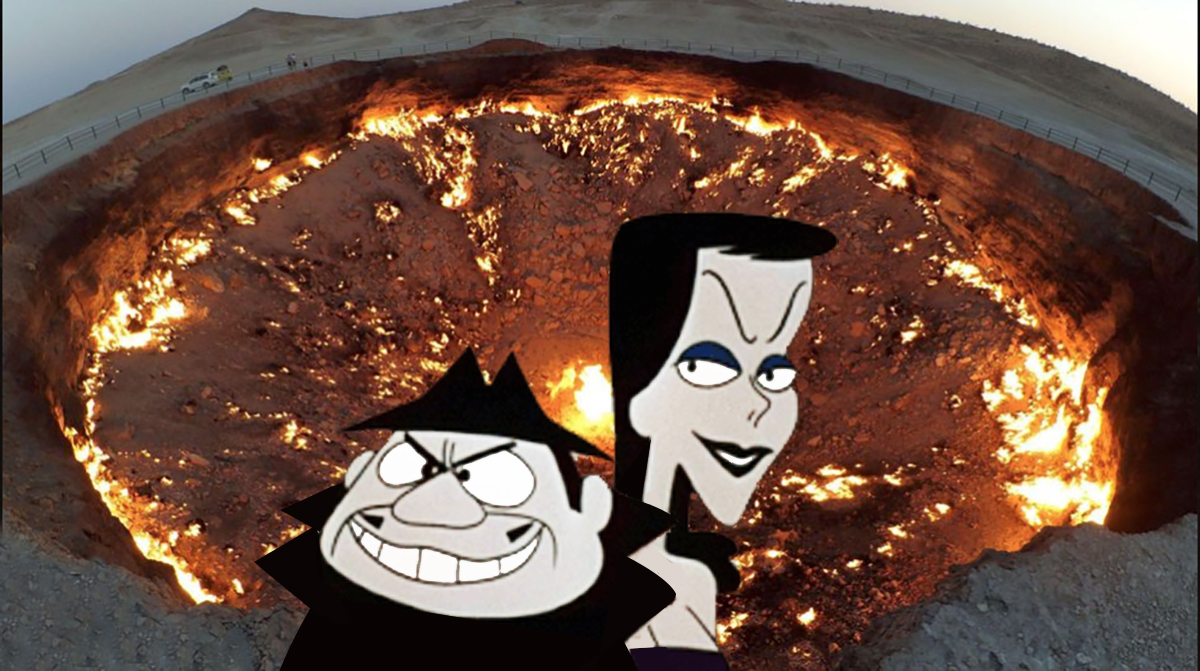
"Boris' Inferno" or "That's One Hell of a Big Hole"


EXT, SKY. Rocky's flying around a flaming, smoking X-Plane plunging straight down to Mother Earth.

Announcer: (OS) We leave Rocky in a valiant attempt to rescue Gary Powers from his X-Plane's death-spiral toward certain doom.

Bullwinkle: (in X-Plane cockpit, wearing pilot's helmet) I'm not really Gary Powers, kids. The story's kinda complicated.

Announcer: Thousands of miles away, Boris and Natasha have been spelunking in the caves of Turkmenistan. This improbable vacation is a last-ditch attempt to rekindle their failing romance. But they discover a fire of a different kind ...

INT, CAVE. Natasha Fatale and Boris Badanov confront a ghastly hellmouth.

Natasha: You see what I see, Boris?

Boris: Is metaphysical question, Natasha. Am high-school drop-out, OK? How should I know?

Natasha: Is horrible pit to hell, Boris!

Boris: As opposed to nice pit to hell?

Natasha: Is not time to be funny, Boris.

Boris: You can say that again.

Natasha: Is not time to …

Boris: Shaddup! Fearless Leader is here.

Fearless Leader is, indeed, standing right behind them.

Natasha: Hello, Fearless Leader.

Fearless Leader: “Hello” pfui! Big problem this is!

Boris: No kidding! Big problem for entire humanity!

Fearless Leader: No, stupid idiot. Big problem for you!

Boris: Ho-boy. Is blame-shifting time?

Fearless Leader: No, Boris. Is time now I pin big heroic medal on your chest.

Boris: Really, Fearless Leader?

Fearless Leader: Really, Boris. Cross heart and hope to die.

Boris: Ho-boy! I fall to my knees Fearless Leader! (Boris does.) Thank you so …

Natasha: Fearless Leader is f**king with you, Boris.

Boris: Wash mouth out with soap, Natasha! Is insult to …

Fearless Leader: Natasha is right, Boris. Natasha is always smart one—and much more sexy.

Natasha: (whispering) Please to get up, Boris.

Boris: OK, OK. Eccch. So embarrassing.

(Boris stands up.)

Fearless Leader: Is touching relationship.

Boris: Not lately.

Fearless Leader: Shaddup! Sexy or not, Natasha is scapegoat, too. Is nothing personal.

Unholy, guttural howls emerge from the flaming vortex.

Natasha: The devil things are making bad noise in hellhole, Fearless Leader.

Fearless Leader: “Hellhole”…?

Natasha points.

Natasha: Rip in space-time continuum, dimensional vortex … whatever. Such terminology is unclear to me, Fearless Leader. Is not my area of training, OK?

Fearless Leader: “Training” … pfui! You are covering for loser boyfriend!

Boris: Am not loser.

Natasha: Is not boyfriend.

Fearless Leader: Shaddup! This hole is “Boris Hole,” obviously. Name is written all over it!

Boris: Is not.

Fearless Leader: I now take closer look.

Natasha: Please not to be getting too close Fearless …

Fearless Leader: Aggghhhh!

Fearless Leader plunges into the hellmouth. Boris and Natasha watch his descent with a mixture of relief and horror.

Boris: Ho-boy. Is loss of recurring character, Natasha. Now what?

Natasha: Now we cut to commercial, Boris. All problems will go away.

Boris: You think, Natasha? Pfui! Is something stupid Americans believe!

Natasha: Is American show, Boris. Wave goodbye.

Boris and Natasha wave. Screams emerge from the gaping wound in time and space.

Cut to — whatever.

Announcer: (OS) Are we back? Wow. That was ... Hi kids! Uh. Don't forget to buy more Cheerios! Or whatever it was. And be sure to tune in to next week's exciting episode of "Rocky and Bullwinkle." Assuming the world is still here. Don't ask me. Nobody tells me anything.

Bullwinkle: (OS) Oh boo-hoo-hoo. You don't hear me complaining.

EXT, view of Bullwinkle inside the doomed X-Plane's cockpit. Rocky's flying around, desperately trying to pry it open.

Rocky: Hang in there, pal.

Bullwinkle: Anything you say, Rock. Anything you say.


"Boris' Inferno" or "That's One Hell of a Big Hole"

Announcer: We leave Rocky in a valiant attempt to rescue Gary Powers from his X-Plane's death-spiral toward certain doom.

Bullwinkle: (in X-Plane cockpit, wearing pilot's helmet) I'm not really Gary Powers. The story's kinda complicated.

Announcer: Thousands of miles away, Boris and Natasha have been spelunking in the caves of Turkmenistan. This improbable vacation is a last-ditch attempt to rekindle their failing romance. But they discover a fire of a different kind ...

INT, cave. Natasha Fatale and Boris Badanov confront a ghastly hellmouth.

Natasha: You see what I see, Boris?

Boris: Is metaphysical question, Natasha. Am high-school drop-out, OK? How should I know?

Natasha: Is horrible pit to hell, Boris!

Boris: As opposed to nice pit to hell?

Natasha: Is not time to be funny, Boris.

Boris: You can say that again.

Natasha: Is not time to …

Boris: Shaddup! Fearless Leader is here.

Fearless Leader is, indeed, standing right behind them.

Natasha: Hello, Fearless Leader.

Fearless Leader: “Hello” pfui! Big problem this is!

Boris: No kidding! Big problem for entire humanity!

Fearless Leader: No, stupid idiot. For you!

Boris: Ho-boy. Is blame-shifting time?

Fearless Leader: No, Boris. Is time now I pin big heroic medal on your chest.

Boris: Really, Fearless Leader?

Fearless Leader: Really, Boris. Cross heart and hope to die.

Boris: Ho-boy! I fall to my knees Fearless Leader! (Boris does.) Thank you so …

Natasha: Fearless Leader is f**king with you, Boris.

Boris: Wash mouth out with soap, Natasha! Is insult to …

Fearless Leader: Natasha is right, Boris. Natasha is always smart one—and much more sexy.

Natasha: (whispering) Please to get up, Boris.

Boris: OK, OK. Yuck. So embarrassing.

(Boris stands up.)

Fearless Leader: Is touching relationship.

Boris: Not lately.

Fearless Leader: Shaddup! Sexy or not, Natasha is scapegoat, too. Is nothing personal.

Unholy, guttural howls emerge from the flaming vortex.

Natasha: The devil things are making noise in hellhole, Fearless Leader.

Fearless Leader: “Hell hole”…?

Natasha points.

Natasha: Rip in space-time continuum, dimensional vortex … whatever. Such terminology is unclear to me, Fearless Leader. Is not my area of training, OK?

Fearless Leader: “Training” … pfui! You are covering for loser boyfriend!

Boris: Am not loser.

Natasha: Is not boyfriend.

Fearless Leader: Shaddup! This hole is “Boris Hole,” obviously. I now take closer look.

Natasha: Please not to be getting too close Fearless …

Fearless Leader: Aggghhhh!

Fearless Leader falls into the hellmouth. Boris and Natasha watch his descent with a mixture of relief and horror.

Boris: Ho-boy. Is loss of recurring character, Natasha. Now what?

Natasha: Now we cut to commercial, Boris. All problems will go away.

Boris: You think, Natasha? Pfui! Is something Americans believe!

Natasha: Is American show, Boris. Wave goodbye.

Boris and Natasha wave. Screams emerge from the hellmouth.

Cut to —